
Mydayis: Uses, Dosage, Side Effects, and Safety Guide
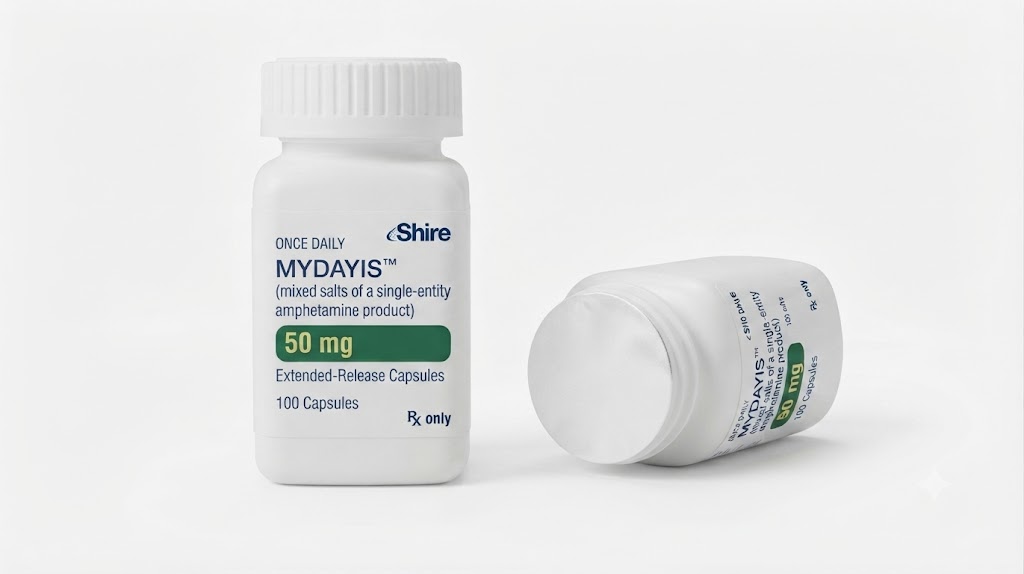
Mydayis packs the same four amphetamine salts found in Adderall XR into a capsule engineered very differently: three separate bead types, timed to release across as much as 16 hours from a single morning dose. Because that’s substantially longer than most other extended-release stimulants, Mydayis’s dosing rules, food guidance, and age restrictions all reflect this extended-duration design. Since it’s a Schedule II controlled substance, it requires the same careful prescribing, monitoring, and secure storage as other amphetamine products.
The information below reflects current FDA prescribing information for Mydayis (revised October 2023). It’s meant for general education, so it doesn’t replace advice from a licensed prescriber or pharmacist.
Product Overview
What Is Mydayis?
Mydayis delivers mixed amphetamine salts — the same active ingredient family as Adderall XR — through a capsule containing three distinct types of beads: one immediate-release bead and two different delayed-release beads, one that releases at pH 5.5 and another at pH 7.0. Because these beads dissolve at different points along the digestive tract, they stagger the drug’s release across the day rather than delivering it all at once or in just two waves.
Active Ingredient
The active ingredients are dextroamphetamine sulfate, amphetamine sulfate, dextroamphetamine saccharate, and amphetamine aspartate monohydrate, combined in equal parts by weight — the same 3:1 ratio of dextro- to levo-amphetamine used in Adderall XR.
Brand Name and Generic Name
Takeda Pharmaceuticals distributes Mydayis (the capsules still carry the “SHIRE 465” imprint from the product’s original developer). No generic version was available as of this writing, though that can change over time.
Drug Classification
Mydayis belongs to the amphetamine class of CNS stimulants. Consequently, the DEA classifies it as a Schedule II controlled substance.
FDA-Approved Uses
Mydayis is approved for one condition, with a narrower age range than some other amphetamine products:
- Attention deficit hyperactivity disorder (ADHD) in patients 13 years of age and older.
Because pediatric patients 12 and younger showed higher drug exposure and higher rates of side effects like insomnia and decreased appetite in clinical trials, and because a lower dose tested in that age group didn’t demonstrate effectiveness, Mydayis isn’t approved for children 12 and under.
Evidence-Supported Off-Label Uses
As with other amphetamine-based stimulants, some clinicians consider off-label use for conditions like treatment-resistant depression augmentation, though this falls outside Mydayis’s approved indication and should only happen under a prescriber’s individualized judgment.
How It Works
Amphetamines block the reuptake of norepinephrine and dopamine into the presynaptic neuron and increase the release of these chemicals into the surrounding space. Researchers haven’t fully defined the exact mechanism behind the resulting ADHD benefit, though this increased signaling is believed to improve attention, focus, and impulse control.
Product Information Table
| Attribute | Detail |
|---|---|
| Brand | Mydayis |
| Generic | Mixed amphetamine salts (triple-bead extended-release) |
| Active Ingredient | Dextroamphetamine sulfate, amphetamine sulfate, dextroamphetamine saccharate, amphetamine aspartate monohydrate |
| Drug Class | CNS stimulant (amphetamine) |
| Manufacturer | Takeda Pharmaceuticals America, Inc. |
| Prescription Status | Prescription only |
| Controlled Drug Schedule | Schedule II (CII) |
| Dosage Forms | Extended-release capsule (triple-bead) |
| Strengths | 12.5 mg, 25 mg, 37.5 mg, 50 mg |
| Administration Route | Oral |
| Onset (peak levels) | Approximately 7–10 hours after dosing |
| Duration of Effect | Designed to last up to 16 hours from a single morning dose |
| Half-Life | d-amphetamine approximately 10–11 hours; l-amphetamine approximately 10–13 hours |
| Storage | Room temperature, 68–77°F (20–25°C); protect from light |
Available Strengths
Each capsule strength has a distinct color combination to help confirm the correct dose.
| Strength | Dosage Form | Color | Imprint |
|---|---|---|---|
| 12.5 mg | Extended-release capsule | Green body, green cap | SHIRE 465, 12.5 mg |
| 25 mg | Extended-release capsule | Ivory body, green cap | SHIRE 465, 25 mg |
| 37.5 mg | Extended-release capsule | Ivory body, light caramel cap | SHIRE 465, 37.5 mg |
| 50 mg | Extended-release capsule | Ivory body, purple cap | SHIRE 465, 50 mg |
If a capsule looks different from what a patient normally receives, they should check with their pharmacist before taking it.
Dosage Guide
Because Mydayis isn’t interchangeable with other amphetamine products on a milligram-per-milligram basis, dosing always starts fresh rather than converting from another stimulant’s dose.
Adults (18 to 55 Years)
The recommended starting dose is 12.5 mg once daily in the morning, though some patients may start at 25 mg. The dose may be increased in 12.5 mg increments, no sooner than weekly, up to a maximum of 50 mg once daily. Doses above 50 mg haven’t shown additional clinical benefit in trials that tested up to 75 mg.
Adolescents (13 to 17 Years)
The recommended starting dose is 12.5 mg once daily in the morning. The dose may be increased in 12.5 mg increments, no sooner than weekly, up to a maximum of 25 mg once daily — half the adult maximum. Doses above 25 mg haven’t been evaluated in this age group.
Children 12 and Under
Mydayis isn’t approved for this age group. Clinical trials found higher drug exposure and more side effects in children 6 to 12, and a lower dose tested in that age group didn’t prove effective.
Older Adults
Clinical studies of Mydayis didn’t include enough patients 65 and older to determine whether they respond differently. Even so, prescribers typically start at the low end of the dosing range in older adults, reflecting the greater likelihood of reduced liver, kidney, or heart function at that age.
Kidney Disease
For adults with severe renal impairment, the maximum recommended dose drops to 25 mg daily. Mydayis isn’t recommended for patients with end-stage renal disease. For adolescents with severe renal impairment, the standard starting dose can be used if tolerated, but shouldn’t be increased beyond that.
Liver Disease
The label doesn’t provide a specific dosing table for liver impairment. Since amphetamine clearance can involve both the liver and kidneys, a prescriber should be informed of any significant liver condition before starting treatment.
How to Take It
Morning Only
Because Mydayis’s effects can last up to 16 hours, it must be taken once daily immediately upon waking. If a dose gets missed, patients shouldn’t take it later in the day or double the next dose — they should simply resume their regular schedule the following morning.
With or Without Food
Patients can take Mydayis with or without food, but should stay consistent with whichever they choose. Food doesn’t change the total amount absorbed, but it delays peak levels substantially — by about five hours for d-amphetamine after a high-fat meal, compared with taking it on an empty stomach.
Swallowing Difficulties
Patients who can’t swallow the capsule whole may open it and sprinkle the contents over a spoonful of applesauce. They should eat the mixture immediately without chewing, and shouldn’t store it for later. A single capsule’s dose shouldn’t be split or divided.
Overdose
Amphetamine overdose can cause dangerously high blood pressure, rapid heartbeat, high body temperature, agitation, hallucinations, or seizures. Anyone who suspects an overdose should call Poison Control at 1-800-222-1222 or go to the nearest emergency room immediately.
Storage and Disposal
Mydayis should be stored in a secure, ideally locked location, protected from light. For disposal, a DEA-authorized take-back program is preferred; alternatively, mixing unused capsules with an undesirable substance like coffee grounds before sealing and discarding them in household trash is an accepted method.
Benefits
For patients with ADHD who need coverage through a long workday or school day without a second dose, Mydayis’s 16-hour design offers something few other stimulants match. Clinical trials measured its effect using timed math-performance tests at 2, 4, 8, 12, 14, and 16 hours after dosing, and found a statistically significant benefit compared with placebo across that entire window in both adults and adolescents.
Side Effects
Stimulant medications affect multiple body systems, so side effects range from mild to serious, and they show up somewhat differently in adults versus adolescents.
Common Side Effects (Adults)
- Insomnia (the most common side effect by far, affecting roughly a third of patients)
- Decreased appetite
- Dry mouth
- Weight loss
- Increased heart rate
- Anxiety
- Feeling jittery or agitated
- Bruxism (teeth grinding)
Common Side Effects (Adolescents)
- Decreased appetite
- Nausea
- Insomnia
- Upper abdominal pain
- Irritability
- Weight loss
- Dizziness
Serious Side Effects
- New or worsening mental health symptoms, including mania or psychosis
- Slowed growth in adolescents
- Circulation problems in fingers or toes (Raynaud’s phenomenon)
- Seizures
- New or worsening tics
- Serotonin syndrome (when combined with certain other medications)
Emergency Symptoms
Patients should seek emergency care immediately for:
- Chest pain, shortness of breath, or fainting
- Signs of serotonin syndrome, such as agitation, high fever, or muscle rigidity
- Unexplained wounds appearing on fingers or toes
- Signs of a severe allergic reaction, such as facial or throat swelling
Drug Interactions
Because amphetamines affect the heart and nervous system, Mydayis interacts with several other substances.
Prescription Drugs
Combining Mydayis with monoamine oxidase inhibitors (MAOIs) is contraindicated due to the risk of hypertensive crisis. Tricyclic antidepressants can cause a sustained increase in brain amphetamine concentrations, and CYP2D6 inhibitors can raise amphetamine exposure — both may require a dose adjustment or an alternative medication.
OTC Medicines
Alkalinizing agents, including some antacids, increase amphetamine blood levels, while acidifying agents lower them. A prescriber may adjust the Mydayis dose based on which type of product a patient regularly uses.
Alcohol
This deserves special attention with Mydayis specifically: laboratory testing found that alcohol increased the rate at which the capsule releases its amphetamine content, particularly at higher alcohol concentrations. Because of this, the label specifically advises against drinking alcohol during Mydayis treatment.
Supplements
St. John’s Wort raises the risk of serotonin syndrome when combined with Mydayis. Patients should disclose all supplement use to their prescriber.
Herbal Products
As with St. John’s Wort above, herbal products with serotonergic or stimulant-like activity should be discussed with a prescriber before combining with Mydayis.
Foods
No specific food restriction applies, but a high-fat meal significantly delays how quickly Mydayis reaches peak levels, so consistency in food timing matters more here than with some shorter-acting stimulants.
Warnings
Mydayis carries an FDA boxed warning for abuse, misuse, and addiction. Misuse — including taking higher doses, using it without a prescription, or altering the route of administration — increases the risk of overdose and death.
The medication also carries warnings for sudden death in patients with underlying heart conditions, increased blood pressure and heart rate, new psychiatric symptoms, growth suppression in adolescents, peripheral vasculopathy, seizures, and serotonin syndrome. A warning specific to Mydayis addresses medication errors: because it isn’t interchangeable with other amphetamine products on a milligram-per-milligram basis, substitution mistakes between products could lead to accidental overdose.
Contraindications
Mydayis should not be used by patients who:
- Have a known hypersensitivity to amphetamine products or other ingredients in Mydayis
- Are taking, or have taken within the past 14 days, a monoamine oxidase inhibitor (MAOI)
Pregnancy
Available data from published literature and postmarketing reports aren’t sufficient to establish a clear drug-associated risk of major birth defects or miscarriage. Animal studies using the same 3:1 amphetamine ratio found no effect on fetal development at doses up to 10 times the maximum recommended human dose, though a separate pre- and postnatal study found decreased pup survival and body weight at clinically relevant doses. A pregnancy exposure registry tracks outcomes for people exposed to Mydayis during pregnancy.
Breastfeeding
Amphetamine does pass into human milk, and the current label specifically advises against breastfeeding during Mydayis treatment, given the potential for serious cardiovascular effects, blood pressure changes, growth suppression, or peripheral vasculopathy in a nursing infant.
Monitoring Requirements
Prescribers typically monitor the following throughout treatment:
- Blood pressure and heart rate at each visit
- Height and weight, checked often in adolescent patients
- Signs of new or worsening psychiatric symptoms
- Signs of misuse, dependence, or diversion
- Family and personal history of tics or Tourette’s syndrome before starting
Storage Instructions
Mydayis should be kept at room temperature, between 68°F and 77°F (20°C to 25°C), protected from light, in a tightly closed container. Patients should store it in a secure, ideally locked, location and never share it with anyone else, since doing so is both dangerous and illegal.
Frequently Asked Questions
What is Mydayis used for?
Mydayis is FDA-approved to treat attention deficit hyperactivity disorder (ADHD) in patients 13 years of age and older, including both adolescents and adults. Because it isn’t approved for children 12 and under, a healthcare provider confirms a patient’s age before considering it.
How is Mydayis different from Adderall XR?
Both contain the same four amphetamine salts in the same ratio, but Mydayis uses three types of release beads instead of Adderall XR’s two, designed to stretch coverage to about 16 hours instead of roughly 10 to 12. Mydayis also starts at a lower approved age (13, versus 6 for Adderall XR) and isn’t interchangeable with Adderall XR on a milligram-per-milligram basis.
What is the typical starting dose of Mydayis?
For adults, the typical starting dose is 12.5 mg once daily, increasing in 12.5 mg steps up to a maximum of 50 mg. For adolescents 13 to 17, the starting dose is also 12.5 mg, but the maximum is lower, at 25 mg per day. A prescriber adjusts the dose based on response and tolerability.
Why must Mydayis be taken only in the morning?
Because Mydayis is designed to release medication over as long as 16 hours, taking it later in the day significantly raises the risk of insomnia. The label specifically instructs taking it immediately upon waking, and never making up a missed dose later that same day.
Can children under 13 take Mydayis?
No. Mydayis isn’t approved for children 12 and under. Clinical trials in that age group found higher drug exposure and more side effects, including higher rates of insomnia and appetite loss, and a lower dose tested didn’t prove effective.
What happens if I miss a dose?
If a morning dose is missed, patients shouldn’t take it later in the day or double the next day’s dose. Instead, they should simply take their next dose at the regular time the following morning.
Can Mydayis be taken with food?
Yes, but consistency matters. Food doesn’t change how much medication the body ultimately absorbs, but it can delay peak blood levels by about five hours compared with taking Mydayis on an empty stomach. Patients should take it the same way — with or without food — every day.
Can I drink alcohol while taking Mydayis?
No, this is specifically discouraged. Laboratory testing found that alcohol can cause Mydayis’s beads to release their amphetamine content more quickly than intended, especially at higher alcohol concentrations, which effectively means a faster, less predictable dose than prescribed.
What are the most common side effects of Mydayis?
In adults, insomnia is by far the most common side effect, followed by decreased appetite, dry mouth, and weight loss. In adolescents, the most common side effects include decreased appetite, nausea, insomnia, and upper abdominal pain. Most side effects are mild to moderate, but anything severe or persistent should be reported to a prescriber.
Is Mydayis addictive?
Yes. Mydayis carries an FDA boxed warning for abuse, misuse, and addiction because it is a Schedule II controlled substance. Even when taken exactly as prescribed, long-term use can lead to physical dependence. Patients should never share their medication, and prescribers routinely reassess abuse risk throughout treatment.
Why shouldn’t Mydayis be substituted for other amphetamine products?
Because Mydayis uses a different combination of amphetamine salts and a different release engineering than other products like Adderall XR, an equal milligram amount doesn’t produce an equivalent drug exposure. Substituting between products without a prescriber’s guidance could lead to accidental overdose or reduced effectiveness.
Can Mydayis interact with antidepressants?
Yes. Combining Mydayis with MAOIs is strictly contraindicated due to the risk of hypertensive crisis, and combining it with SSRIs, SNRIs, or tricyclic antidepressants raises the risk of serotonin syndrome. Patients should disclose every medication, including antidepressants, to their prescriber before starting Mydayis.
Is Mydayis safe during pregnancy or breastfeeding?
Available data haven’t established a clear risk of major birth defects during pregnancy, though animal studies showed some effects at clinically relevant doses in later development stages. For breastfeeding, the current label specifically recommends against it during Mydayis treatment, given the potential for serious effects in a nursing infant.
Can adults over 55 take Mydayis?
Mydayis’s clinical trials focused on adults ages 18 to 55, so data in older adults remain limited. Prescribers typically start at the lowest end of the dosing range in older patients, given the higher likelihood of reduced organ function or other health conditions at that age.
What should I do if I think I’ve taken too much Mydayis?
Suspected overdose is a medical emergency. Symptoms can include a rapid heartbeat, dangerously high body temperature, severe agitation, hallucinations, or seizures. Call Poison Control at 1-800-222-1222 or go to the nearest emergency room immediately rather than waiting to see if symptoms improve.
Conclusion
Mydayis takes a familiar set of active ingredients and re-engineers their release into a genuinely longer-lasting capsule, aimed at patients 13 and older who need coverage through a full day without a second dose. That extended design brings real tradeoffs worth understanding — a more pronounced food-timing effect, a specific alcohol interaction, and stricter morning-only dosing rules — alongside the same class-wide warnings around cardiovascular risk, psychiatric symptoms, and abuse potential shared by other amphetamine products. Patients and caregivers who understand these specifics, rather than assuming Mydayis behaves just like Adderall XR, will be better equipped to use it safely.
| Pill | 30, 60, 100, 150, 200 |
|---|
Be the first to review “Mydayis”
Related products
ADHD
ADHD
ADHD
ADHD
ADHD
ADHD
ADHD
Reviews
There are no reviews yet.