
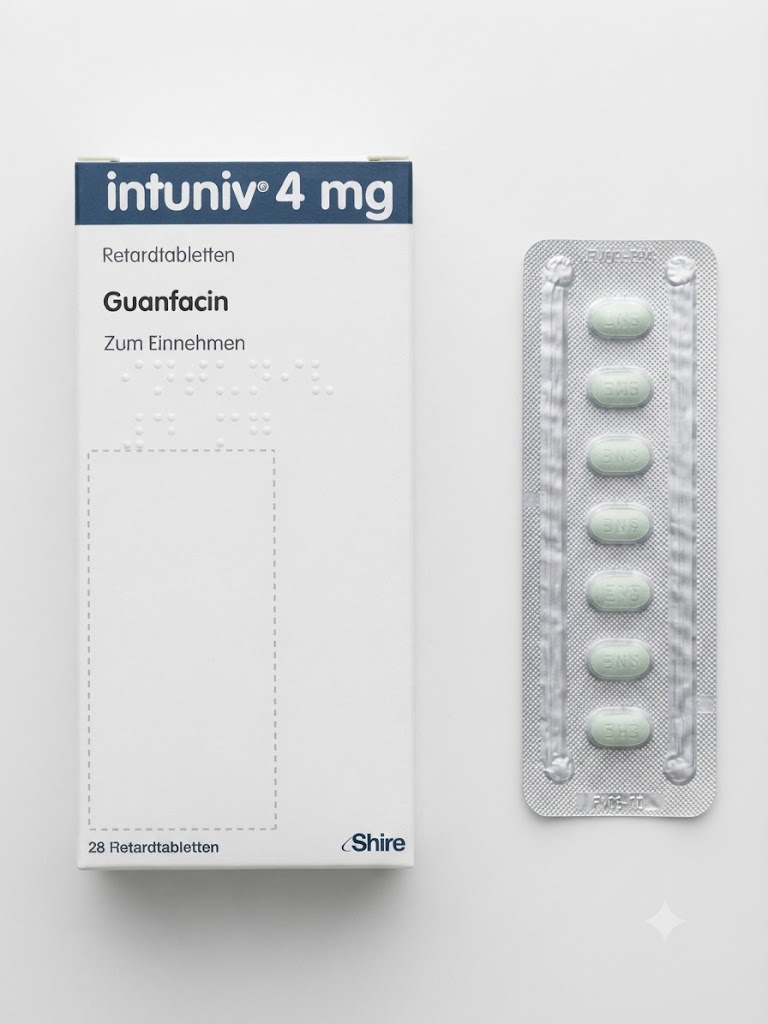


Intuniv: Uses, Dosage, Side Effects, and Safety Guide
Intuniv treats ADHD through a completely different pathway than stimulants or Strattera, because it works on blood pressure–regulating receptors in the brain rather than on dopamine or norepinephrine reuptake in the same way. Since it’s an extended-release formulation of guanfacine, prescribers often use it either on its own or alongside a stimulant medication. Because it’s not a controlled substance and carries no abuse-related boxed warning, its safety profile centers instead on cardiovascular effects like low blood pressure and slowed heart rate.
The information below reflects current FDA prescribing information for Intuniv. It’s meant for general education, so it doesn’t replace advice from a licensed prescriber or pharmacist.
Product Overview
What Is Intuniv?
Intuniv delivers guanfacine in an extended-release tablet, engineered specifically for ADHD treatment. Takeda Pharmaceuticals brought it to market in 2009, decades after guanfacine’s original approval as a blood pressure medication under the brand name Tenex. Because Intuniv’s extended-release technology changes the drug’s absorption pattern substantially, it isn’t simply “Tenex, but slower” — the two products behave quite differently in the body.
Active Ingredient
The active ingredient is guanfacine, formulated as an extended-release tablet using a specialized release technology that spreads absorption out over the day.
Brand Name and Generic Name
Takeda Pharmaceuticals America, Inc. manufactures and distributes Intuniv. Since generic guanfacine extended-release tablets have also reached the market, patients have more than one option for filling this prescription.
Drug Classification
Intuniv belongs to a class called central alpha-2A adrenergic receptor agonists. Because it isn’t a controlled substance, it carries no DEA schedule, unlike the stimulant medications covered elsewhere in this series.
FDA-Approved Uses
The FDA approves Intuniv for one indication:
- Attention deficit hyperactivity disorder (ADHD) in children and adolescents ages 6 to 17, used either as monotherapy or as an add-on to stimulant medication.
Notably, Intuniv isn’t approved for adults with ADHD, which sets it apart from many other ADHD treatments covered in this series.
Evidence-Supported Off-Label Uses
Beyond ADHD, clinicians sometimes prescribe guanfacine off-label for tic disorders, including Tourette’s syndrome, since research suggests it may reduce tic severity in some patients. It’s also been studied for conditions like PTSD-related hyperarousal. Because these uses fall outside Intuniv’s approved indication, they should only happen under individualized prescriber judgment.
How It Works
Guanfacine selectively stimulates alpha-2A adrenergic receptors in the brain, which reduces sympathetic nervous system signaling to the heart and blood vessels. Researchers haven’t fully established the precise mechanism behind its ADHD benefit, though the leading theory points to guanfacine’s effects on the prefrontal cortex, the brain region responsible for attention and impulse control.
Product Information Table
| Attribute | Detail |
|---|---|
| Brand | Intuniv |
| Generic | Guanfacine extended-release |
| Active Ingredient | Guanfacine |
| Drug Class | Central alpha-2A adrenergic receptor agonist (non-stimulant) |
| Manufacturer | Takeda Pharmaceuticals America, Inc.; generic manufacturers also available |
| Prescription Status | Prescription only |
| Controlled Substance Status | Not a controlled substance |
| Dosage Forms | Extended-release tablet |
| Strengths | 1 mg, 2 mg, 3 mg, 4 mg |
| Administration Route | Oral |
| Onset of Action | Gradual; full benefit often takes several weeks to appear |
| Duration of Effect | Once-daily dosing, morning or evening |
| Half-Life | Guanfacine’s elimination half-life runs roughly 10–30 hours (average around 17 hours), though the extended-release formulation changes how the drug gets absorbed, not how it’s eventually cleared |
| Storage | Room temperature, protected from excess heat and moisture |
Available Strengths
Each tablet strength has a distinct color and shape, which helps confirm the dose at a glance.
| Strength | Dosage Form | Color | Shape |
|---|---|---|---|
| 1 mg | Extended-release tablet | White | Round |
| 2 mg | Extended-release tablet | White | Oval |
| 3 mg | Extended-release tablet | Green | Round |
| 4 mg | Extended-release tablet | Green | Oval |
Because generic guanfacine ER may look different depending on the manufacturer, patients should confirm with their pharmacist if a refilled tablet looks unfamiliar.
Dosage Guide
Because Intuniv’s dosing depends heavily on body weight, a prescriber calculates the target range individually rather than using a single fixed dose for every patient.
Children and Adolescents (Ages 6–17)
Treatment starts at 1 mg once daily, either in the morning or evening, and increases in steps of no more than 1 mg per week based on response and tolerability. From there, a prescriber targets a weight-based dose range of about 0.05 to 0.12 mg/kg per day, generally falling somewhere between 1 mg and 7 mg total per day, as shown below.
| Weight | Target Dose Range |
|---|---|
| 25–33.9 kg | 2–3 mg/day |
| 34–41.4 kg | 2–4 mg/day |
| 41.5–49.4 kg | 3–5 mg/day |
| 49.5–58.4 kg | 3–6 mg/day |
| 58.5–91 kg | 4–7 mg/day |
| Over 91 kg | 5–7 mg/day |
Because doses above 4 mg/day haven’t been evaluated in children ages 6–12, and doses above 7 mg/day haven’t been evaluated in adolescents ages 13–17, prescribers stay within these studied ranges.
Adults
Since the FDA hasn’t approved Intuniv for adult ADHD, the label doesn’t include a corresponding adult dosing regimen. Any adult use would fall outside the approved indication.
Older Adults
Because Intuniv’s safety and effectiveness haven’t been established in geriatric patients, this age group falls outside its studied population entirely.
Kidney Disease
Since guanfacine’s clearance involves both the kidneys and the liver, significant kidney impairment may call for a dose reduction. Patients on hemodialysis generally don’t need major adjustments, though, since only a small fraction of the drug gets cleared through dialysis.
Liver Disease
Because roughly half of guanfacine’s clearance happens in the liver, significant liver impairment may also require a lower dose. That said, researchers haven’t specifically assessed how liver impairment affects guanfacine levels in children, so a prescriber would rely on clinical judgment in that population.
How to Take It
Before Meals
Patients should avoid taking Intuniv with a high-fat meal, since doing so significantly increases how much of the drug the body absorbs. Because of this, consistent timing relative to meals matters more with Intuniv than with many other ADHD medications.
After Meals
Outside of the high-fat-meal caution above, patients can generally take Intuniv at a consistent time each day, whether that’s morning or evening, based on what works best for their routine and any sedation they experience.
Missed Dose
If a single dose gets missed, patients simply resume their normal schedule at the next scheduled time. If two or more consecutive doses get missed, though, a prescriber may want to reconsider the restart dose based on how well the patient tolerated treatment before the gap.
Switching From Tenex
Because Intuniv and Tenex aren’t interchangeable milligram-for-milligram — Intuniv has notably lower peak levels, lower overall bioavailability, and a delayed peak compared with the same dose of immediate-release guanfacine — patients switching between them need a fresh titration rather than a direct dose substitution.
Discontinuing Treatment
Unlike Strattera, Intuniv does require a gradual taper when stopping, since abrupt discontinuation can cause rebound hypertension — a potentially serious spike in blood pressure above the patient’s original baseline. Because of this, prescribers typically reduce the dose by no more than 1 mg every three to seven days, while monitoring blood pressure and heart rate along the way.
Overdose
Because guanfacine overdose can cause dangerously low blood pressure, a slowed heart rate, and significant drowsiness, anyone who suspects an overdose should call Poison Control at 1-800-222-1222 or seek emergency medical care right away.
Storage
Patients should store Intuniv at room temperature, away from excess heat and moisture, and out of reach of children.
Benefits
Because Intuniv isn’t a controlled substance, it offers a meaningful non-stimulant option for children and adolescents who can’t tolerate stimulants, who have a family history of substance use concerns, or whose ADHD symptoms respond better with an add-on medication alongside a stimulant. Clinical trials also found that long-term Intuniv treatment didn’t slow growth in height or weight compared with normative data — a reassuring finding for a medication used in a pediatric population over extended periods.
Side Effects
Because guanfacine affects the cardiovascular and nervous systems together, its side effects differ meaningfully from stimulant or serotonergic medications.
Common Side Effects
- Somnolence (sleepiness)
- Fatigue
- Nausea
- Lethargy
- Hypotension (low blood pressure)
- Abdominal pain
- Dizziness
- Dry mouth
- Irritability
- Headache
Less Common Side Effects
- Constipation
- Weakness
- Decreased appetite
- Anxiety
Serious Side Effects
- Significant drops in blood pressure or heart rate, including fainting (syncope)
- Cardiac conduction abnormalities, especially in patients already prone to slow heart rhythms
- Rebound hypertension after abrupt discontinuation, sometimes severe enough to cause hypertensive encephalopathy
- Excessive sedation, particularly when combined with other sedating substances
Emergency Symptoms
Because these signs can indicate a medical emergency, patients should seek immediate care for:
- Fainting, severe dizziness, or a very slow heartbeat
- A sudden, severe spike in blood pressure after missing doses or stopping treatment
- Signs of a severe allergic reaction, such as facial or throat swelling
Drug Interactions
Because guanfacine is metabolized mainly through a liver enzyme called CYP3A4, and because it affects blood pressure and heart rate directly, it interacts with a fairly specific set of substances.
Prescription Drugs
Strong and moderate CYP3A4 inhibitors — such as ketoconazole — significantly raise guanfacine blood levels, so the dose typically gets cut in half when starting or continuing Intuniv alongside one of these. By contrast, CYP3A4 inducers like carbamazepine lower guanfacine levels, so a prescriber may consider doubling the Intuniv dose instead. Notably, Intuniv doesn’t meaningfully change methylphenidate or lisdexamfetamine levels when combined, so those particular stimulant combinations don’t require their own dose adjustment.
OTC Medicines
Because many cough-and-cold products and diet aids affect blood pressure or the nervous system, patients should check with a pharmacist before combining them with Intuniv.
Alcohol
Since alcohol adds to Intuniv’s sedative effects, patients should avoid drinking while taking it. This combination can intensify drowsiness well beyond what either substance would cause alone.
Supplements
The current label doesn’t flag specific supplement interactions, but patients should disclose all supplement use to their prescriber regardless, particularly anything marketed for sleep, relaxation, or blood pressure support.
Herbal Products
As with supplements generally, herbal products that affect blood pressure, sedation, or liver enzyme activity deserve the same disclosure and caution.
Foods
Because a high-fat meal significantly increases how much guanfacine the body absorbs from Intuniv specifically, patients should take it consistently around meals rather than sometimes with a heavy meal and sometimes without.
Warnings
Intuniv’s warnings center on its cardiovascular effects rather than abuse potential or suicidality. Because guanfacine lowers blood pressure and heart rate by design, it can cause hypotension, bradycardia, and fainting, particularly in patients who already have a tendency toward these issues or who take other blood-pressure-lowering medications.
Beyond that, Intuniv commonly causes sedation and somnolence, which is why patients should avoid alcohol and use caution before driving or operating machinery until they know how the medication affects them. It can also worsen certain cardiac conduction problems, and abruptly stopping it can trigger rebound hypertension serious enough, in rare cases, to cause hypertensive encephalopathy.
Contraindications
Patients shouldn’t take Intuniv if they:
- Have a history of hypersensitivity to Intuniv, its inactive ingredients, or any other product containing guanfacine
Because this list is notably shorter than the contraindications for stimulant medications or Strattera, Intuniv’s risk profile centers more on cautious use in at-risk patients than on absolute exclusions.
Pregnancy
Because available data span decades of guanfacine use in pregnant women, though relatively infrequently, they haven’t identified a clear drug-associated risk of major birth defects, miscarriage, or adverse pregnancy outcomes. Animal studies at three to four times the maximum recommended human dose showed no adverse effects, though higher doses did reduce fetal survival alongside maternal toxicity. A pregnancy exposure registry tracks outcomes for people exposed to ADHD medications, including Intuniv, during pregnancy.
Breastfeeding
No human data currently exist on whether guanfacine passes into breast milk, though animal studies show it does appear in the milk of lactating rats. Because of this, a prescriber should weigh the benefits of breastfeeding against the mother’s clinical need for treatment.
Monitoring Requirements
Throughout treatment, prescribers typically monitor:
- Blood pressure and heart rate at baseline, after dose increases, and periodically during treatment
- Signs of excessive sedation, especially early in treatment
- Height and weight in pediatric patients over time
- Blood pressure and pulse closely during any dose reduction or discontinuation
Storage Instructions
Patients should store Intuniv at room temperature, away from excess heat and moisture, and out of reach of children.
Frequently Asked Questions
What is Intuniv used for?
Intuniv treats attention deficit hyperactivity disorder (ADHD) in children and adolescents ages 6 to 17, either used alone or added to a stimulant medication. Because it isn’t approved for adults, a healthcare provider evaluates a patient’s age alongside their ADHD diagnosis before prescribing it.
Can Intuniv be combined with a stimulant?
Yes. Unlike some ADHD medications, Intuniv’s FDA approval specifically covers use as an add-on to stimulant treatment, not just as a standalone option. Because guanfacine doesn’t meaningfully change methylphenidate or lisdexamfetamine levels, combining Intuniv with those particular stimulants doesn’t require a special dose adjustment for either medication.
What is the typical starting dose of Intuniv?
Treatment starts at 1 mg once daily, then increases in steps of no more than 1 mg per week, based on response and tolerability. From there, a prescriber targets a weight-based range of roughly 0.05 to 0.12 mg/kg per day, which typically works out to somewhere between 1 mg and 7 mg total daily.
Can adults take Intuniv?
Not under Intuniv’s current FDA approval, which covers only children and adolescents ages 6 to 17. Because adult dosing hasn’t been established for this specific formulation, any adult use would fall outside the approved indication.
How is Intuniv different from Tenex?
Both contain guanfacine, but Intuniv’s extended-release design changes its absorption significantly — it produces a 60% lower peak concentration, 43% lower overall bioavailability, and a peak that arrives three hours later than the same dose of immediate-release guanfacine (Tenex). Because of these differences, the two products aren’t interchangeable milligram-for-milligram, and Intuniv is FDA-approved for ADHD, while Tenex is approved for high blood pressure.
Why can’t Intuniv be taken with a high-fat meal?
Because a high-fat meal significantly increases how much guanfacine the body absorbs from the extended-release tablet, taking Intuniv this way can push blood levels higher than intended. To keep dosing predictable, patients should take it consistently, ideally without a heavy, high-fat meal at the same time.
What happens if a dose is missed?
If a single dose is missed, patients simply pick back up with their normal schedule at the next dose. If two or more doses in a row get missed, though, a prescriber may want to restart at a lower dose and re-titrate, since tolerance to guanfacine’s effects can shift during a gap in treatment.
Can I stop taking Intuniv abruptly?
No. Because abruptly stopping Intuniv can cause rebound hypertension — a spike in blood pressure above the original baseline — prescribers typically taper the dose down gradually, by no more than 1 mg every three to seven days, while monitoring blood pressure and heart rate.
What are the most common side effects of Intuniv?
The most frequently reported side effects include sleepiness, fatigue, nausea, lethargy, and low blood pressure. Because these effects tend to be dose-related, they often become less pronounced as treatment continues, but patients should still report anything severe or persistent to their prescriber.
Is Intuniv addictive?
No. Because Intuniv isn’t a controlled substance and guanfacine doesn’t produce the reinforcing effects associated with stimulant medications, it carries essentially no risk of abuse or addiction in the way stimulant ADHD medications do.
Can Intuniv affect blood pressure or heart rate?
Yes, significantly. Because Intuniv works by activating receptors that reduce sympathetic nervous system activity, it commonly lowers both blood pressure and heart rate as part of its intended effect. This is why prescribers monitor these values closely, especially during dose increases.
Can Intuniv interact with other medications?
Yes. Strong CYP3A4 inhibitors like ketoconazole raise guanfacine levels significantly, usually requiring a dose cut in half, while CYP3A4 inducers like carbamazepine lower guanfacine levels, sometimes prompting a dose increase instead. Because alcohol and other sedating medications can intensify Intuniv’s drowsiness, patients should disclose their full medication list to their prescriber.
Is Intuniv safe during pregnancy?
Available data collected over decades of guanfacine use in pregnancy haven’t identified a clear risk of major birth defects or miscarriage, though this use has been relatively infrequent overall. A pregnancy exposure registry tracks outcomes for people exposed to Intuniv during pregnancy, and anyone who is pregnant or planning pregnancy should discuss their options with their prescriber.
Can Intuniv tablets be crushed or opened?
No. Because crushing, chewing, or breaking an Intuniv tablet increases how quickly it releases guanfacine, patients should always swallow it whole. Altering the tablet defeats the extended-release design that spreads the dose out over the day.
What should I do if too much Intuniv was taken?
Suspected overdose is a medical emergency, since it can cause dangerously low blood pressure, a very slow heart rate, and significant drowsiness. Because of this, patients should call Poison Control at 1-800-222-1222 or go to the nearest emergency room immediately rather than waiting to see if symptoms improve.
Conclusion
Intuniv fills a distinct niche among ADHD treatments, because it works through blood pressure–regulating receptors rather than dopamine or norepinephrine pathways, and because it’s specifically approved for both standalone use and stimulant add-on therapy in children and adolescents. That mechanism brings real advantages — no abuse potential and evidence it doesn’t slow growth — but it also demands careful attention to blood pressure, heart rate, and a proper tapering schedule when stopping treatment. Because Intuniv’s safety profile differs so much from stimulants and from Strattera, patients and caregivers benefit from understanding its cardiovascular considerations clearly before starting.
| Pills | 150, 200 |
|---|
Be the first to review “Intuniv”
Related products
ADHD

ADHD
ADHD

ADHD
ADHD
ADHD
Reviews
There are no reviews yet.