
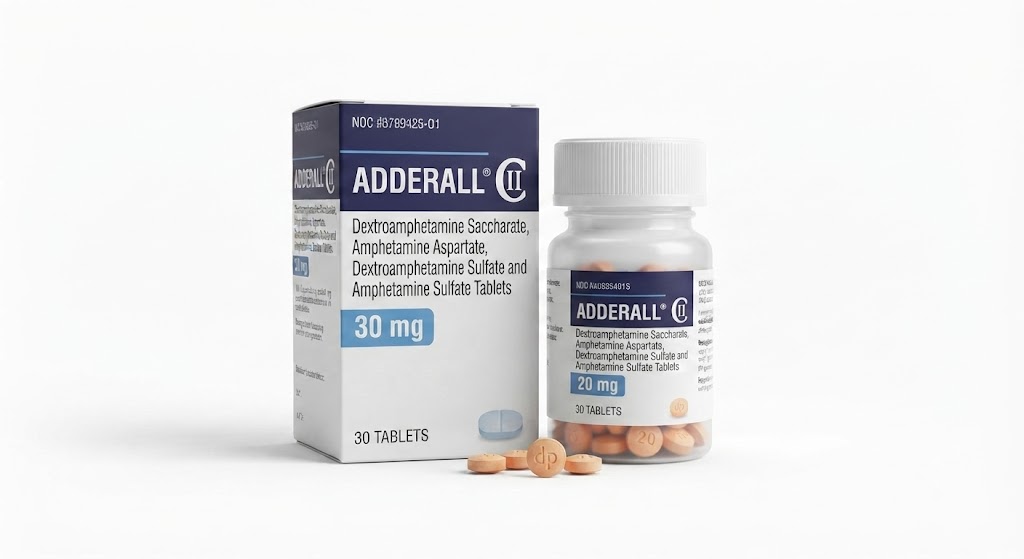

Adderall is a prescription stimulant that doctors use to treat attention-deficit/hyperactivity disorder (ADHD) and narcolepsy. It is one of the most commonly prescribed ADHD medications in the United States. Many patients and families have questions about how it works, how to take it, and also what to expect.
Product Overview
| Detail | Information |
|---|---|
| Brand Name | Adderall (IR), Adderall XR |
| Generic Name | Mixed amphetamine salts |
| Active Ingredients | Dextroamphetamine saccharate, amphetamine aspartate monohydrate, dextroamphetamine sulfate, amphetamine sulfate |
| Drug Class | CNS stimulant/amphetamine |
| Prescription Status | Prescription only (Rx) |
| Controlled Substance | Schedule II (DEA) |
| FDA-Approved Uses | ADHD (ages 3+), narcolepsy (ages 6+) |
| Available Forms | IR tablets, XR capsules |
| IR Strengths | 5 mg, 7.5 mg, 10 mg, 12.5 mg, 15 mg, 20 mg, 30 mg |
| XR Strengths | 5 mg, 10 mg, 15 mg, 20 mg, 25 mg, 30 mg |
| Onset of Action | 30–60 min (IR); 60–90 min (XR) |
| Duration of Action | 4–6 hours (IR); 10–12 hours (XR) |
| Half-life | Approximately 9–14 hours |
| Storage | 68°F–77°F (20°C–25°C); locked, secure location |
What Is Adderall?
Adderall is a brand-name medication that contains mixed amphetamine salts. It comes in two forms. Adderall IR is an immediate-release tablet. Adderall XR is an extended-release capsule. Both contain the same active ingredients but release them at different rates.
The U.S. Drug Enforcement Administration (DEA) classifies Adderall as a Schedule II controlled substance. This means it has accepted medical uses, but also a significant risk of misuse and dependence. As a result, it requires a new written prescription at every refill. Pharmacies cannot accept a phone-in refill for this medication.
Generic versions of both IR and XR are widely available in the United States. They contain the same active ingredients as the brand-name versions. Talk to your pharmacist about whether a generic is appropriate for your prescription.
How Does Adderall Work?
The Role of Dopamine and Norepinephrine
Adderall increases the levels of two brain chemicals: dopamine and norepinephrine. These chemicals help brain cells communicate with each other. They play a key role in attention, motivation, and impulse control.
Adderall works in two ways. Firstly, it triggers nerve cells to release more dopamine and norepinephrine. Second, it blocks those cells from reabsorbing the chemicals too quickly. Both actions increase signaling in brain regions associated with focus and self-control.
Why Adderall Helps With ADHD
In people with ADHD, dopamine signaling works differently than in those without the condition. Studies suggest that stimulant medications like Adderall help correct this imbalance. As a result, many patients experience improved focus, reduced impulsivity, and better behavioral control.
It may seem counterintuitive that a stimulant calms behavior. However, researchers believe this happens because the medication targets specific brain circuits linked to self-regulation. The effect is well-established in clinical studies across both children and adults.
Adderall IR vs Adderall XR: What Is the Difference?
Both forms treat the same conditions. However, they work on different schedules. Your doctor will choose the right form based on your lifestyle, age, and symptoms.
Immediate Release (IR)
Adderall IR starts working within 30 to 60 minutes. The effects last 4 to 6 hours. Most patients take it two or three times daily. This gives doctors more control over timing and dosing. It also allows patients to skip a dose in the evening if sleep becomes a concern.
Extended Release (XR)
Adderall XR takes 60 to 90 minutes to kick in. However, its effects last 10 to 12 hours. Patients take it just once every morning. This makes it easier to manage and reduces the need for a midday dose at school or work.
Side-by-Side Comparison
| Feature | Adderall IR | Adderall XR |
|---|---|---|
| Form | Tablet | Capsule |
| Daily doses | 2–3 | 1 |
| Onset | 30–60 minutes | 60–90 minutes |
| Duration | 4–6 hours | 10–12 hours |
| Capsule can be opened? | N/A | Yes — sprinkle on applesauce |
| Approved age (ADHD) | 3 years and older | 6 years and older |
FDA-Approved Uses of Adderall
Adderall for ADHD in Children
The FDA approves Adderall IR for ADHD in children aged 3 and older. Adderall XR is approved for children aged 6 and older. Doctors use it to treat the three core symptoms of ADHD: inattention, hyperactivity, and impulsivity. Children on long-term treatment need regular monitoring for growth, heart rate, and blood pressure.
Adderall for ADHD in Adults
Adult ADHD is a recognized medical condition. Many adults go undiagnosed until later in life. Adderall is an effective and widely used treatment option for adults managing ADHD symptoms at work, home, and in relationships.
Adderall for Narcolepsy
The FDA also approves Adderall for narcolepsy in patients aged 6 and older. Narcolepsy is a neurological condition that causes sudden, uncontrollable episodes of sleep. Adderall helps patients stay alert and awake during the day.
Off-Label Uses (not FDA-approved)
Some doctors prescribe Adderall off-label as an adjunct treatment for treatment-resistant depression. This use is not FDA-approved. The evidence is limited and mixed. Off-label prescribing should only happen after a careful, individualized evaluation by a qualified physician.
Important: Adderall is not approved for weight loss. Using it for this purpose is medically inappropriate and carries serious risks.
Adderall Dosage Guide
Your doctor determines your exact dose. The ranges below reflect typical FDA-labeled guidance only. Do not adjust your dose without medical supervision.
Children With ADHD (Ages 3–5) — IR Only
- Starting dose: 2.5 mg once daily
- Titration: Increase by 2.5 mg each week until the response is adequate
- Maximum dose: Set individually by the prescriber
Children With ADHD (Ages 6–17)
Adderall IR:
- Starting dose: 5 mg once or twice daily
- Titration: Increase by 5 mg each week
- Maximum dose: 40 mg per day for most patients
Adderall XR:
- Starting dose: 5–10 mg once daily in the morning
- Titration: Increase by 5–10 mg each week
- Maximum dose: 30 mg per day
Adults With ADHD
Adderall IR:
- Starting dose: 5 mg once or twice daily
- Titration: Increase weekly as needed
Adderall XR:
- Starting dose: 20 mg once daily in the morning
- Maximum dose: 40 mg per day for most patients
Narcolepsy (Ages 6 and Older)
- Starting dose: 10 mg per day
- Titration: Increase by 10 mg each week
- Typical daily range: 5–60 mg in divided doses
Special Populations
Elderly patients: Limited clinical data exists. Use cautiously with close monitoring of blood pressure and heart rate.
Renal impairment: No official dose adjustment exists in the labeling. However, doctors monitor carefully, since amphetamines are cleared partly through the kidneys.
Hepatic impairment: No official dose adjustment exists. Monitor closely and discuss with your prescriber.
How to Take Adderall
Follow your doctor’s instructions exactly. These tips apply to most patients.
- Take Adderall in the morning to avoid sleep problems at night
- Take it with or without food — both are fine
- Swallow IR tablets whole with a full glass of water
- For XR capsules: swallow whole, or open and sprinkle the beads onto a teaspoon of applesauce — eat immediately and do not chew the beads
- Take it at the same time every day to maintain consistent levels
- Never crush, chew, or snort Adderall — this is dangerous and illegal
- Store it securely in a locked cabinet away from children and others
What to Do If You Miss a Dose
Skip the dose if it is already the afternoon or evening. Take your next scheduled dose the following morning. Never take two doses on the same day to make up for a missed one.
What to Do in an Overdose
An Adderall overdose is a medical emergency. Call 911 or Poison Control at 1-800-222-1222 right away. Do not wait for symptoms to worsen. Signs of overdose include:
- Rapid or irregular heartbeat
- High fever
- Severe agitation or panic
- Uncontrollable shaking or tremors
- Hallucinations or confusion
- Seizures
- Loss of consciousness
Benefits of Adderall
When prescribed and used appropriately, Adderall offers several well-established benefits:
- Improved attention span and the ability to stay on task
- Reduced impulsivity and hyperactive behavior
- Better academic and work performance in many patients
- Reduced daytime sleepiness in narcolepsy
- A choice of IR or XR formulations to fit different schedules
- Wide availability in generic form, lowering cost for many patients
Common and Serious Side Effects
Common Side Effects
These are the most frequently reported effects, especially in the first few weeks:
- Decreased appetite
- Weight loss
- Dry mouth
- Insomnia or difficulty sleeping
- Headache
- Irritability or mood changes
- Increased heart rate
- Stomach upset or nausea
- Dizziness
- Anxiety or nervousness
Most of these improve as the body adjusts to the medication. Tell your doctor if they persist or become bothersome.
Less Common Side Effects
- Constipation or diarrhea
- Excessive sweating
- Fatigue as the dose wears off (“rebound effect”)
- Decreased sex drive
- Hair thinning (rare)
Serious Side Effects
Contact your doctor promptly if you notice:
- A significant rise in blood pressure or heart rate
- Chest pain or heart palpitations
- Signs of psychosis — hallucinations, paranoid thoughts, or seeing/hearing things
- Sudden aggression or extreme mood changes
- Signs of serotonin syndrome — fever, muscle stiffness, agitation, rapid heart rate
- Numbness, coldness, or color changes in fingers or toes (Raynaud’s phenomenon)
- Slowed height or weight gain in children
Emergency Symptoms — Call 911 Immediately
- Chest pain or difficulty breathing
- Symptoms of stroke (face drooping, arm weakness, speech difficulty)
- Seizures
- Loss of consciousness
- Thoughts of self-harm or suicide
Drug Interactions
Always give your doctor and pharmacist a full list of medications, supplements, and herbal products you take. Adderall interacts with many substances.
Prescription Drug Interactions
| Drug or Drug Class | Risk |
|---|---|
| MAOIs (e.g., phenelzine, selegiline) | Contraindicated — risk of life-threatening hypertensive crisis; avoid within 14 days |
| SSRIs / SNRIs (e.g., fluoxetine, venlafaxine) | Increased risk of serotonin syndrome |
| Tricyclic antidepressants | May raise blood levels of both drugs |
| Antihypertensive medications | Adderall may reduce their blood-pressure-lowering effect |
| Lithium | May reduce the stimulant effect of Adderall |
| Proton pump inhibitors/antacids | May increase amphetamine absorption |
| Seizure medications | Adderall may alter seizure threshold |
OTC Medications and Supplements
- Decongestants (e.g., pseudoephedrine): additive cardiovascular effects
- High-dose vitamin C (ascorbic acid): may reduce Adderall absorption
- Herbal stimulants (ephedra, guarana, high-dose ginseng): additive stimulant risk — avoid
Food and Alcohol Interactions
- Alcohol: Avoid completely. It increases cardiovascular strain and impairs judgment.
- Caffeine: Limit intake. Combining it with Adderall may worsen anxiety and raise heart rate.
- Acidic foods and drinks taken at the same time as a dose may slightly reduce absorption.
Warnings and Precautions
FDA Boxed Warning
Adderall carries the FDA’s most serious label warning — the Boxed Warning. CNS stimulants have a high potential for misuse, abuse, and dependence. Misuse can lead to serious cardiovascular events and, in rare cases, sudden death. Keep Adderall in a secure location. Never share it with anyone else. Sharing a controlled substance is illegal.
Cardiovascular Risks
Adderall raises blood pressure and heart rate. Patients with pre-existing heart conditions face a higher risk of serious events. Before starting treatment, your doctor should review your cardiovascular history and may perform a heart check. Report any chest pain, irregular heartbeat, or shortness of breath to your doctor right away.
Psychiatric Risks
Adderall can trigger or worsen anxiety, psychosis, mania, and aggression. This can happen even in patients with no previous history of mental illness. Tell your doctor immediately about any sudden changes in mood, behavior, or thinking.
Dependence and Withdrawal
Long-term use can cause physical and psychological dependence. Do not stop taking Adderall suddenly after prolonged use. Stopping abruptly may cause withdrawal symptoms such as extreme fatigue, low mood, and disturbed sleep. Always taper under your doctor’s guidance.
Growth Suppression in Children
Stimulant medications may slow height and weight gain in children during long-term treatment. Your child’s doctor will track growth at every visit. In some cases, they may recommend planned breaks from the medication — sometimes called “drug holidays” — to support normal development.
Who Should Not Take Adderall?
Do not take Adderall if you:
- Have a known allergy to amphetamines or any ingredient in the formulation
- Have used a monoamine oxidase inhibitor (MAOI) in the past 14 days
- Have symptomatic heart disease or a structural heart defect
- Have moderate to severe high blood pressure
- Have hyperthyroidism (overactive thyroid)
- Have glaucoma
- Have a history of significant drug or alcohol misuse
- Are in a state of severe anxiety or agitation
Your doctor will also carefully evaluate whether Adderall is appropriate if you have a history of bipolar disorder, psychosis, or other psychiatric conditions.
Adderall and Pregnancy
Doctors do not recommend Adderall during pregnancy. Amphetamines may increase the risk of premature birth and low birth weight. Newborns exposed to amphetamines late in pregnancy may also experience withdrawal symptoms after birth.
No large, well-controlled studies in pregnant women currently exist. Your doctor will assess the risks and benefits carefully if you are pregnant and need treatment for ADHD or narcolepsy.
Breastfeeding: Adderall is also not recommended while breastfeeding. Amphetamines pass into breast milk and may cause irritability and poor sleep in nursing infants. Speak openly with your doctor about your feeding options before starting treatment.
Monitoring Requirements
Regular follow-up with your prescriber keeps you safe throughout treatment. Your doctor will typically monitor:
- Blood pressure and heart rate — before starting and at every follow-up visit
- Weight — especially important in children and patients with appetite concerns
- Height — in children, to track for growth suppression
- Mood and mental health — at every visit; report changes between appointments
- Signs of misuse or dependence — your prescriber may ask about your usage patterns
- Sleep quality — insomnia is common and can affect overall health
Strength Comparison Table
Note: Tablet and capsule colors may vary by manufacturer. Verify current appearance with your pharmacist.
Adderall IR Tablets
| Strength | Form | Color | Typical Use |
|---|---|---|---|
| 5 mg | Tablet | White | Low starting dose; dose-sensitive patients |
| 7.5 mg | Tablet | Blue | Early titration step |
| 10 mg | Tablet | Blue | Common pediatric starting dose |
| 12.5 mg | Tablet | Orange | Mid titration step |
| 15 mg | Tablet | Orange | Mid-range maintenance |
| 20 mg | Tablet | Orange | Common adult maintenance dose |
| 30 mg | Tablet | Orange | Upper-range adult dose |
Adderall XR Capsules
| Strength | Form | Color | Typical Use |
|---|---|---|---|
| 5 mg | Capsule | Clear/blue | Low starting dose |
| 10 mg | Capsule | Blue/blue | Pediatric starting dose |
| 15 mg | Capsule | Blue/white | Mid-titration step |
| 20 mg | Capsule | Orange/orange | Standard adult starting dose |
| 25 mg | Capsule | Orange/white | Upper-range titration |
| 30 mg | Capsule | Orange/clear | Maximum XR dose |
Frequently Asked Questions About Adderall
1. What is Adderall used for? The FDA approves Adderall to treat ADHD in patients aged 3 and older, and narcolepsy in patients aged 6 and older. It is not approved for weight loss.
2. What is the difference between Adderall IR and XR? Adderall IR is a tablet that works for 4 to 6 hours. Most patients take it two to three times daily. Adderall XR is a capsule that lasts 10 to 12 hours and is taken once in the morning.
3. How long does Adderall stay in your system? Adderall has a half-life of roughly 9 to 14 hours. However, urine drug screens can detect amphetamines for up to 72 hours after the last dose. Detection times vary by dose, frequency of use, kidney function, and individual metabolism.
4. Is Adderall addictive? Yes, Adderall carries a real risk of physical and psychological dependence. The DEA classifies it as Schedule II for this reason. When taken exactly as prescribed under medical supervision, the risk is managed — but not eliminated.
5. Can I drink alcohol while taking Adderall? No. Avoid alcohol completely during Adderall treatment. The combination increases cardiovascular strain and significantly impairs judgment and reaction time.
6. Does Adderall cause weight loss? Decreased appetite and weight loss are common side effects. However, Adderall is not approved for weight loss. Using it for this purpose is medically inappropriate and dangerous.
7. Can children take Adderall safely? Yes, with appropriate medical supervision. The FDA approves Adderall IR for children aged 3 and older, and Adderall XR for children aged 6 and older. Doctors monitor growth, heart rate, blood pressure, and mood throughout treatment.
More FAQ’s
1. What should I do if I miss a dose? Skip the missed dose if it is already the afternoon or evening. Take your next dose the following morning at your usual time. Never take a double dose.
2. Can Adderall be taken with antidepressants? It depends on the antidepressant. Combining Adderall with MAOIs is dangerous and contraindicated. Combining it with SSRIs or SNRIs increases the risk of serotonin syndrome. Always tell your doctor about every medication you take before starting Adderall.
3. What happens if I stop taking Adderall suddenly? Stopping abruptly after long-term use can cause withdrawal symptoms. These include extreme fatigue, low mood, increased appetite, and disrupted sleep. Always taper your dose gradually under your doctor’s guidance.
4. How long does Adderall XR last? Adderall XR typically provides 10 to 12 hours of therapeutic effect from a single morning dose. This covers most of the school or work day without a midday dose.
5. Can I open an Adderall XR capsule? Yes, if you have difficulty swallowing capsules. Open the XR capsule and sprinkle the entire contents onto a teaspoon of applesauce. Swallow it immediately. Do not chew the beads. Do not store the mixture for later use.
6. Does Adderall interact with vitamins or supplements? Yes. High-dose vitamin C (ascorbic acid) may reduce Adderall absorption. Herbal stimulants such as ephedra or guarana add to the cardiovascular effects of Adderall. Always tell your pharmacist about all supplements you take.
7. Is there a generic version of Adderall available? Yes. Generic mixed amphetamine salts are widely available in both IR and XR formulations in the United States. They contain the same active ingredients as the brand-name versions. Ask your pharmacist about availability and cost.
Storage Instructions
- Store at room temperature: 68°F–77°F (20°C–25°C)
- Keep the container tightly closed at all times
- Avoid bathrooms and kitchens, where heat and moisture can degrade the medication
- Store in a locked cabinet — Adderall is a controlled substance with genuine misuse potential
- Keep all medications out of reach of children and pets
- Do not use after the expiration date on the label
- Dispose of unused medication through an authorized drug take-back program — do not flush or throw in household trash unless specifically directed
Conclusion
Adderall is a well-established, FDA-approved medication for ADHD and narcolepsy. It works by increasing dopamine and norepinephrine activity in the brain. Many patients experience meaningful improvements in focus, impulse control, and daily functioning. However, Adderall is a Schedule II controlled substance. It carries real risks of misuse, dependence, and serious side effects. For that reason, careful prescribing, honest communication with your doctor, and regular monitoring are essential throughout treatment.
If you think Adderall may be right for you or your child, speak with a licensed healthcare professional. They can evaluate your symptoms, review your health history, and determine the safest and most effective treatment plan for your individual needs.
Medical Disclaimer
This article is for educational purposes only. It does not constitute medical advice, a diagnosis, or a treatment recommendation. Adderall is a prescription-only, federally controlled substance. Never start, stop, or change your dose based on information from this page alone.
Always consult a licensed healthcare professional — your doctor, psychiatrist, or pharmacist — before making any decisions about your medication. If you believe you are experiencing a medical emergency, call 911 immediately. For non-emergency poison concerns, contact Poison Control at 1-800-222-1222.
| Pills | 30, 60, 100, 150, 200 |
|---|
Be the first to review “Adderall IR”
Related products
ADHD
ADHD
ADHD

ADHD
ADHD
ADHD
ADHD
ADHD
Reviews
There are no reviews yet.