

Evekeo: Uses, Dosage, Side Effects, and Safety Guide
Evekeo treats three different conditions: attention deficit hyperactivity disorder (ADHD), narcolepsy, and, for short-term use, exogenous obesity. Because it contains racemic amphetamine sulfate — an even mix of the d- and l-amphetamine isomers — it behaves somewhat differently from purely dextro-based stimulants like Dexedrine. Since it’s a Schedule II controlled substance, careful prescribing, ongoing monitoring, and secure storage all matter here.
The guidance below reflects current FDA prescribing information for Evekeo (revised October 2025). It’s meant for general education, so it doesn’t replace advice from a licensed prescriber or pharmacist.
Product Overview
What Is Evekeo?
Evekeo delivers amphetamine sulfate in an immediate-release tablet. Unlike Dexedrine or Adderall, which lean toward the more stimulating d-isomer, Evekeo splits the dose evenly between d- and l-amphetamine. As a result, its cardiovascular effects and appetite-suppressing power differ somewhat from purely dextro-based products, even though both belong to the same amphetamine family.
Active Ingredient
The active ingredient is amphetamine sulfate, formulated as a 1:1 racemic mixture of dextroamphetamine and levoamphetamine.
Brand Name and Generic Name
Azurity Pharmaceuticals currently manufactures and distributes Evekeo. Because “amphetamine sulfate” also serves as the generic name, other manufacturers can produce equivalent generic tablets under that same name.
Drug Classification
Evekeo belongs to the amphetamine class of CNS stimulants. Consequently, the DEA classifies it as a Schedule II controlled substance, reflecting its high potential for misuse.
FDA-Approved Uses
Evekeo carries three separate FDA approvals, which sets it apart from most other stimulants in this class:
- Narcolepsy, across a broad age range.
- Attention deficit hyperactivity disorder (ADHD), as part of a total treatment program, in children 3 years of age and older.
- Exogenous obesity, as a short-term adjunct (a few weeks) to a calorie-restricted weight-reduction plan, specifically for patients who haven’t responded to other approaches. This use applies only in patients 12 and older.
Evidence-Supported Off-Label Uses
Occasionally, clinicians prescribe Evekeo off-label for adult ADHD, since the underlying amphetamine class has strong adult evidence even though Evekeo’s own labeling centers on pediatric ADHD dosing. Because this falls outside the approved indication, it should only happen under close, individualized prescriber judgment.
How It Works
Amphetamines increase the release of norepinephrine and dopamine while also blocking their reuptake into the presynaptic neuron. Researchers still haven’t pinned down the exact mechanism behind the resulting improvement in attention, wakefulness, or appetite suppression, though the increased signaling appears central to all three effects.
Product Information Table
| Attribute | Detail |
|---|---|
| Brand | Evekeo |
| Generic | Amphetamine sulfate |
| Active Ingredient | Amphetamine sulfate (1:1 d- and l-amphetamine) |
| Drug Class | CNS stimulant (amphetamine) |
| Manufacturer | Azurity Pharmaceuticals, Inc. |
| Prescription Status | Prescription only |
| Controlled Drug Schedule | Schedule II (CII) |
| Dosage Forms | Immediate-release tablet |
| Strengths | 5 mg, 10 mg |
| Administration Route | Oral |
| Onset of Action | Consistent with other immediate-release amphetamines; effects begin within roughly 30–60 minutes |
| Duration of Effect | Approximately 4–6 hours per dose |
| Half-Life | Generally 10–13 hours, in line with other amphetamine-class stimulants |
| Storage | Room temperature, 68–77°F (20–25°C) |
Available Strengths
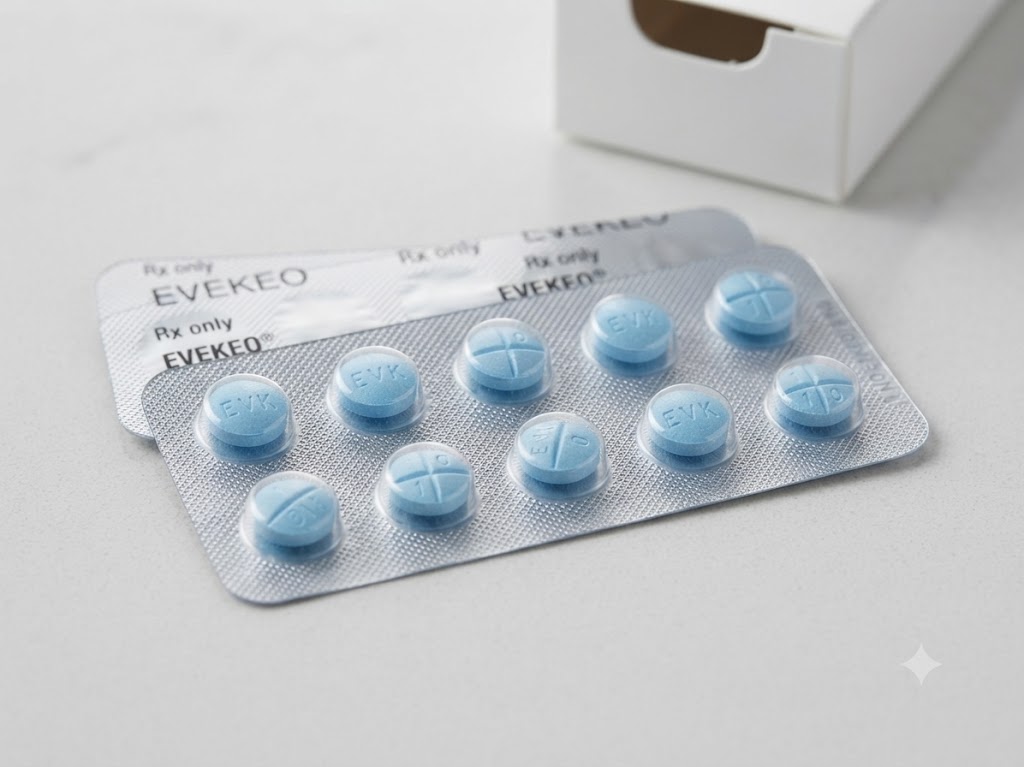
Each tablet strength has a distinct color and score pattern, so patients can confirm their dose at a glance.
| Strength | Dosage Form | Color | Imprint |
|---|---|---|---|
| 5 mg | Immediate-release tablet, round, scored | White | “EVK” / “5” |
| 10 mg | Immediate-release tablet, round, scored | Blue | “EVK” / “10” |
Because generic amphetamine sulfate tablets can look different depending on the manufacturer, always double-check with a pharmacist if a refilled tablet looks unfamiliar.
Dosage Guide
Dosing depends heavily on the condition being treated, the patient’s age, and how they respond, so a prescriber always sets the exact starting point and any adjustments.
Children (ADHD)
For children ages 3 to 5, treatment usually starts at 2.5 mg once daily, with weekly increases of 2.5 mg as needed. For children 6 and older, dosing typically starts at 5 mg once or twice daily, with weekly increases of 5 mg. Because higher doses rarely add benefit, total daily dosing seldom exceeds 40 mg.
Adults
Evekeo’s formal ADHD dosing table addresses pediatric patients specifically, so the label doesn’t spell out a distinct adult ADHD regimen. That said, adults can still be prescribed Evekeo for narcolepsy or short-term obesity treatment, both of which do include adult dosing guidance below.
Narcolepsy (Adults and Children)
For narcolepsy, the usual dose ranges from 5 mg to 60 mg per day in divided doses, and a prescriber tailors this to individual response. Since narcolepsy is uncommon before age 12, pediatric guidance exists mainly for older children: ages 6 to 12 typically start at 5 mg daily, while patients 12 and older typically start at 10 mg daily, with weekly increases as needed.
Exogenous Obesity
For short-term weight management, the usual dose reaches up to 30 mg daily, split into 5–10 mg doses taken 30 to 60 minutes before meals. Because safety data in younger patients is limited, this use doesn’t apply to children under 12.
Older Adults
Evekeo’s current label doesn’t include a dedicated geriatric dosing section. Even so, prescribers typically apply extra caution in older adults, starting low and monitoring closely for cardiovascular effects.
Kidney Disease
The label doesn’t provide specific dosing guidance for kidney impairment. Still, because amphetamines are partly cleared through the kidneys, a prescriber may choose to monitor more closely or adjust the dose in patients with significant kidney disease.
Liver Disease
Similarly, the label doesn’t detail dosing for liver impairment. A prescriber should nonetheless know about any significant liver condition before starting treatment.
How to Take It
Before Meals
For ADHD and narcolepsy, patients take the first dose on waking, generally with or without food. For exogenous obesity specifically, though, timing matters more: patients take each dose 30 to 60 minutes before a meal, since this timing supports the appetite-suppressing effect.
After Meals
Outside of the obesity indication, food timing stays flexible. Even so, keeping a consistent daily schedule tends to produce more predictable symptom control.
Missed Dose
If a dose slips by, patients should generally take it as soon as they remember — unless doing so would push it too close to bedtime or the next scheduled dose, in which case they should just skip it. Either way, doses should never be doubled up.
Overdose
Amphetamine overdose can trigger dangerously high blood pressure, a racing heart, elevated body temperature, agitation, hallucinations, or seizures. Because these effects can escalate quickly, anyone who suspects an overdose should call Poison Control at 1-800-222-1222 or head to the nearest emergency room right away.
Storage and Disposal
Patients should store Evekeo in a secure, ideally locked, location at room temperature. When it’s time to dispose of leftover medication, a DEA-authorized take-back program works best; alternatively, mixing unused tablets with an undesirable substance like used coffee grounds, then sealing and discarding them in household trash, is an accepted method.
Benefits
Because Evekeo covers three distinct indications, it offers unusual flexibility within the stimulant class. For ADHD and narcolepsy, it works through the same mechanism as other amphetamines, while its short-term obesity indication reflects its decades-long history as one of the original “anorectic” stimulants. Since it’s an older, well-established molecule, prescribers also benefit from a long track record of clinical experience.
Side Effects
Because stimulants affect several body systems at once, side effects range from mild to serious.
Common Side Effects
- Headache
- Stomachache
- Trouble sleeping
- Decreased appetite
- Unpleasant taste
- Nervousness
- Dizziness
- Dry mouth
Less Common Side Effects
- Sexual problems, including impotence in males
- Vomiting
- Itching
- Diarrhea or constipation
- Weight loss
- Mood swings
Serious Side Effects
- New or worsening mental health symptoms, including mania or psychosis
- Slowed growth in children
- Seizures
- Circulation problems in fingers or toes (Raynaud’s phenomenon)
- New or worsening tics
- Serotonin syndrome, when combined with certain other medications
- Rare reports of cardiomyopathy with long-term use
Emergency Symptoms
Because these signs can indicate a medical emergency, patients should seek immediate care for:
- Chest pain, shortness of breath, or fainting
- Signs of serotonin syndrome, such as agitation, high fever, or confusion
- A seizure
- Signs of a severe allergic reaction, such as facial or throat swelling
Drug Interactions
Since amphetamines affect the heart, nervous system, and urinary pH balance, Evekeo interacts with a notably wide range of substances.
Prescription Drugs
Combining Evekeo with monoamine oxidase inhibitors (MAOIs) is contraindicated, since doing so can trigger a hypertensive crisis. Serotonergic medications — including SSRIs, SNRIs, triptans, tricyclic antidepressants, fentanyl, lithium, tramadol, and buspirone — raise the risk of serotonin syndrome. Meanwhile, CYP2D6 inhibitors like paroxetine and fluoxetine can increase Evekeo’s effect by slowing its breakdown.
OTC Medicines
Alkalinizing agents such as sodium bicarbonate increase amphetamine absorption and blood levels, so combining them isn’t advised. By contrast, acidifying agents — including some vitamin C products and fruit juices — actually lower amphetamine absorption and efficacy.
Alcohol
Although the label doesn’t detail a specific alcohol interaction, alcohol still adds cardiovascular strain when combined with any stimulant. For that reason, patients should tell their prescriber about their alcohol use before starting treatment.
Supplements
St. John’s Wort raises the risk of serotonin syndrome, much like prescription antidepressants do. Because of this, patients should always disclose supplement use to their prescriber, not just prescription medications.
Herbal Products
As with St. John’s Wort, other herbal products with stimulant-like or serotonergic activity deserve the same caution and disclosure.
Foods
Acidic foods and juices can modestly lower amphetamine absorption, following the same mechanism as acidifying medications described above. Otherwise, no major food restriction applies outside the timing requirement for the obesity indication.
Warnings
Evekeo carries an FDA boxed warning — the agency’s strongest safety warning — for abuse, misuse, and addiction. Because misuse increases the risk of overdose and death, this applies whether someone takes higher doses, uses the drug without a prescription, or alters how it’s taken (for example, snorting or injecting it).
Beyond that, Evekeo’s warnings cover sudden death in patients with underlying heart conditions, elevated blood pressure and heart rate, new psychiatric symptoms, seizures, serotonin syndrome, peripheral vasculopathy (including Raynaud’s phenomenon), and new or worsening tics. Notably, the label also specifically cautions against prescribing amphetamines to patients with even mild hypertension.
Contraindications
Patients shouldn’t take Evekeo if they:
- Have a known hypersensitivity to amphetamine products
- Are currently taking, or have taken within the past 14 days, a monoamine oxidase inhibitor (MAOI)
Pregnancy
Because no adequate, well-controlled studies exist in pregnant women, prescribers rely mainly on older animal data here: amphetamines have shown embryotoxic and teratogenic effects in certain mouse strains at high doses, though not in rabbit or rat studies at lower dose multiples. As a result, Evekeo should only be used during pregnancy if the potential benefit clearly outweighs the potential risk to the fetus. Additionally, infants born to mothers dependent on amphetamines face a higher risk of premature delivery, low birth weight, and withdrawal symptoms after birth.
Breastfeeding
Since amphetamines pass into human milk, the current labeling advises against breastfeeding during Evekeo treatment.
Monitoring Requirements
Throughout treatment, prescribers typically monitor:
- Blood pressure and heart rate at each visit
- Height and weight, especially in pediatric patients
- Signs of new or worsening psychiatric symptoms
- Signs of misuse, dependence, or diversion
- Family and personal history of tics or Tourette’s syndrome before starting
Storage Instructions
Patients should store Evekeo at room temperature, between 68°F and 77°F (20°C to 25°C), in a well-closed container. Because it’s a controlled substance, it belongs in a secure, ideally locked, location — and patients should never share it with anyone else, since doing so is both dangerous and illegal.
Frequently Asked Questions
What is Evekeo used for?
Evekeo treats three separate conditions: narcolepsy, ADHD in children 3 and older, and, for a short time, exogenous obesity in patients 12 and older who haven’t responded to other weight-loss approaches. Because the FDA approved it for all three, a healthcare provider selects the appropriate dosing strategy based on which condition they’re treating.
How is Evekeo different from Dexedrine or Adderall?
Unlike Dexedrine, which contains only dextroamphetamine, Evekeo splits its amphetamine content evenly between the d- and l-isomers. Compared with Adderall, which uses a mix of four different amphetamine salts, Evekeo relies on a single salt form — amphetamine sulfate — in that same 1:1 isomer ratio. These structural differences can lead to somewhat different side-effect profiles from patient to patient.
What is the typical starting dose of Evekeo for ADHD?
For children ages 3 to 5, treatment usually starts at 2.5 mg once daily. For children 6 and older, dosing typically starts at 5 mg once or twice daily. From there, a prescriber raises the dose gradually — usually in 2.5 mg or 5 mg increments — based on response, and total daily doses rarely exceed 40 mg.
Can Evekeo treat weight loss?
Yes, but only as a short-term option. The FDA approved Evekeo as a few-week adjunct to a calorie-restricted diet, specifically for adults and adolescents 12 and older who haven’t responded to other weight-loss methods. Because amphetamines lose much of their appetite-suppressing effect over time, this isn’t intended as a long-term weight-management solution.
Can adults take Evekeo for ADHD?
Evekeo’s formal ADHD dosing guidance centers on pediatric patients, so the label doesn’t include a distinct adult ADHD regimen. Even so, adults can be prescribed Evekeo for narcolepsy, which does carry adult dosing guidance. Any adult ADHD use would depend on individualized clinical judgment.
How long does a dose of Evekeo last?
A single dose generally provides symptom coverage for about 4 to 6 hours, consistent with other immediate-release amphetamine products. Because of this relatively short duration, patients being treated for ADHD or narcolepsy often need a second dose later in the day.
Can Evekeo be taken with food?
For ADHD and narcolepsy, yes — Evekeo can generally be taken with or without food. For exogenous obesity, though, timing matters more: patients take it 30 to 60 minutes before meals to support its appetite-suppressing effect.
What happens if a dose is missed?
If a dose is missed, patients should take it as soon as they remember, unless that would push it too close to bedtime or the next dose. In that case, skipping the missed dose works better than doubling up, since doubling raises the risk of side effects.
What are the most common side effects of Evekeo?
The most frequently reported side effects include headache, stomachache, trouble sleeping, decreased appetite, unpleasant taste, nervousness, and dizziness. Because most of these are mild, they often improve as the body adjusts, but patients should still report anything severe or persistent to their prescriber.
Is Evekeo addictive?
Yes. Because Evekeo is a Schedule II controlled substance, it carries an FDA boxed warning for abuse, misuse, and addiction. Even when taken exactly as prescribed, long-term use can still lead to physical dependence, which is why prescribers reassess abuse risk throughout treatment.
Can Evekeo cause serotonin syndrome?
Yes. Combining Evekeo with serotonergic medications — such as SSRIs, SNRIs, triptans, or St. John’s Wort — raises the risk of this potentially life-threatening reaction. Because of that risk, patients should disclose every medication and supplement they take before starting Evekeo.
Is Evekeo safe during pregnancy?
Since no adequate, well-controlled studies exist in pregnant women, Evekeo should only be used during pregnancy if the potential benefit clearly outweighs the potential risk to the fetus. Anyone who is pregnant or planning pregnancy should discuss this tradeoff directly with their prescriber.
Can Evekeo interact with antidepressants?
Yes, in more than one way. Tricyclic antidepressants can cause a striking, sustained rise in brain amphetamine levels, while SSRIs and SNRIs raise the risk of serotonin syndrome. Because of these interactions, patients taking any antidepressant should make sure their prescriber knows before starting Evekeo.
Why does Evekeo carry a caution about mild hypertension?
Because amphetamines reliably raise blood pressure and heart rate, even patients with mild, well-controlled hypertension face added cardiovascular strain on this medication. As a result, the label specifically calls for extra caution in this group, beyond the general cardiac warnings that apply to all patients.
What should I do if too much Evekeo was taken?
Suspected overdose is always a medical emergency, since symptoms like a racing heart, dangerously high body temperature, severe agitation, or seizures can escalate fast. Because of that, patients should call Poison Control at 1-800-222-1222 or go straight to the nearest emergency room rather than waiting to see if symptoms improve.
Conclusion
Evekeo stands apart from most other stimulants because a single medication covers three FDA-approved uses: ADHD, narcolepsy, and short-term obesity treatment. Its racemic composition — an even split between d- and l-amphetamine — also sets it apart pharmacologically from purely dextro-based products like Dexedrine. Even so, it shares the same class-wide warnings around cardiovascular risk, psychiatric symptoms, serotonin syndrome, and abuse potential that apply across the amphetamine family. Because Evekeo’s dosing and warnings vary meaningfully by indication, patients and caregivers benefit from understanding which use applies to them specifically, along with the broader safety picture covered in this guide.
| Pills | 30, 60, 100, 150, 200 |
|---|
Be the first to review “Evekeo”
Related products
ADHD
ADHD

ADHD
ADHD
ADHD
ADHD
ADHD
ADHD
Reviews
There are no reviews yet.